
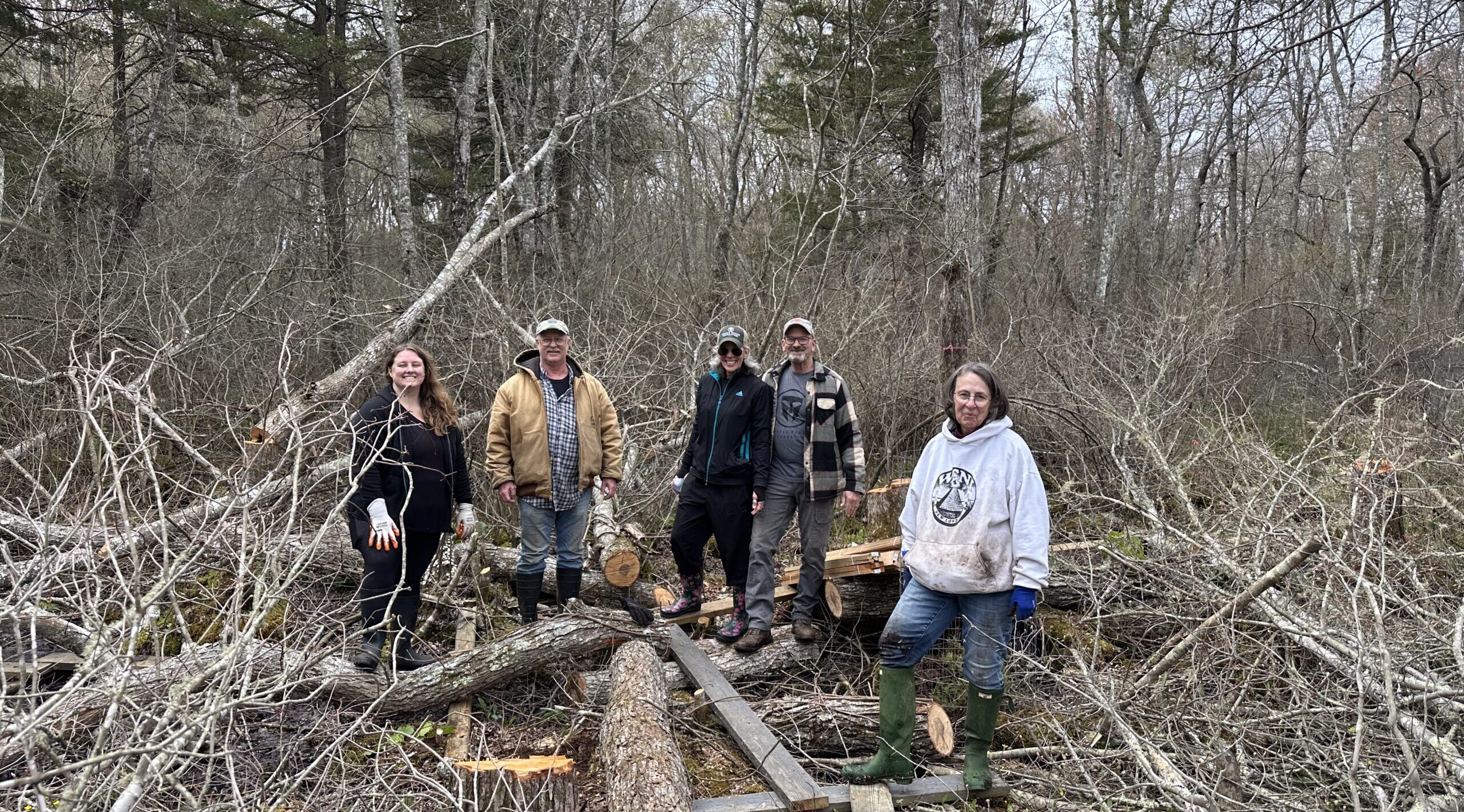
Springtime Sprint of Restoration Work along Anguilla Brook!
In partnership with Eastern Connecticut Conservation District (ECCD), Avalonia builds off its past success in the restoration of a portion of the Anguilla Brook Northern Headwaters preserve.
Last year ECCD was awarded an Urban Forested Natural Areas and Riparian Corridor Restoration Grant from CT DEEP for the Anguilla Brook Northern Headwaters Restoration Project. The funding has assisted in the restoration of two distinct areas of significant riparian and forested wetland habitat, within Avalonia Land Conservancy’s 64-acre Anguilla Brook Northern Headwaters Preserve, spanning the Towns of North Stonington and Stonington, Connecticut. The focus has been on restoration of a portion of a highly erodible riparian corridor and an Atlantic white cedar swamp and will serve to improve water quality, enhance biodiversity, and engage the community through volunteer site preparation and planting, water monitoring, and education outreach. Avalonia stewardship and ECCD staff, interns, and volunteers have played a key role in this work!
The northern portion of this restoration work, involves enhancing an Atlantic white cedar (AWC) swamp, one of a handful of critical habitat types in the state and one that is particularly imperiled. By removing invasive vegetation, creating openings, and planting 100 seedlings near existing AWC stands, this project increases acreage, supports long-term sustainability, improves stand age diversity, and reduces habitat fragmentation. This builds on a successful previous restoration effort, funded by the Connecticut Botanical Society, in which nearly 150 AWC seedlings of different ages were planted and protected. This new phase of work offers a key opportunity to regenerate the population and enhance wildlife habitat, including for species of Greatest Conservation Need.
The more southerly part of the restoration work consists of the removal of invasive vegetation and the planting of more than 30 native trees along the banks of Anguilla Brook. In addition to helping to improve water quality and increasing overall diversity, these deep rooted native plants will reduce runoff, deposition, and soil erosion. Increasing the ecological health and resilience at the headwaters of Anguilla Brook will have positive impacts downstream, along Aguilla Brook, and throughout the Inner Wequetequock Cove Watershed.
To read more about our past restoration efforts and the ecological importance of these forested wetlands see:
https://avalonia.org/connecticut-botanical-society-field-trip-to-anguilla-brook-northern-headwaters-preserves/
https://avalonia.org/avalonia-is-recipient-of-connecticut-botanical-society-grant/