Story and Photos by Sharon J Lynch (Avalonia Board Member)
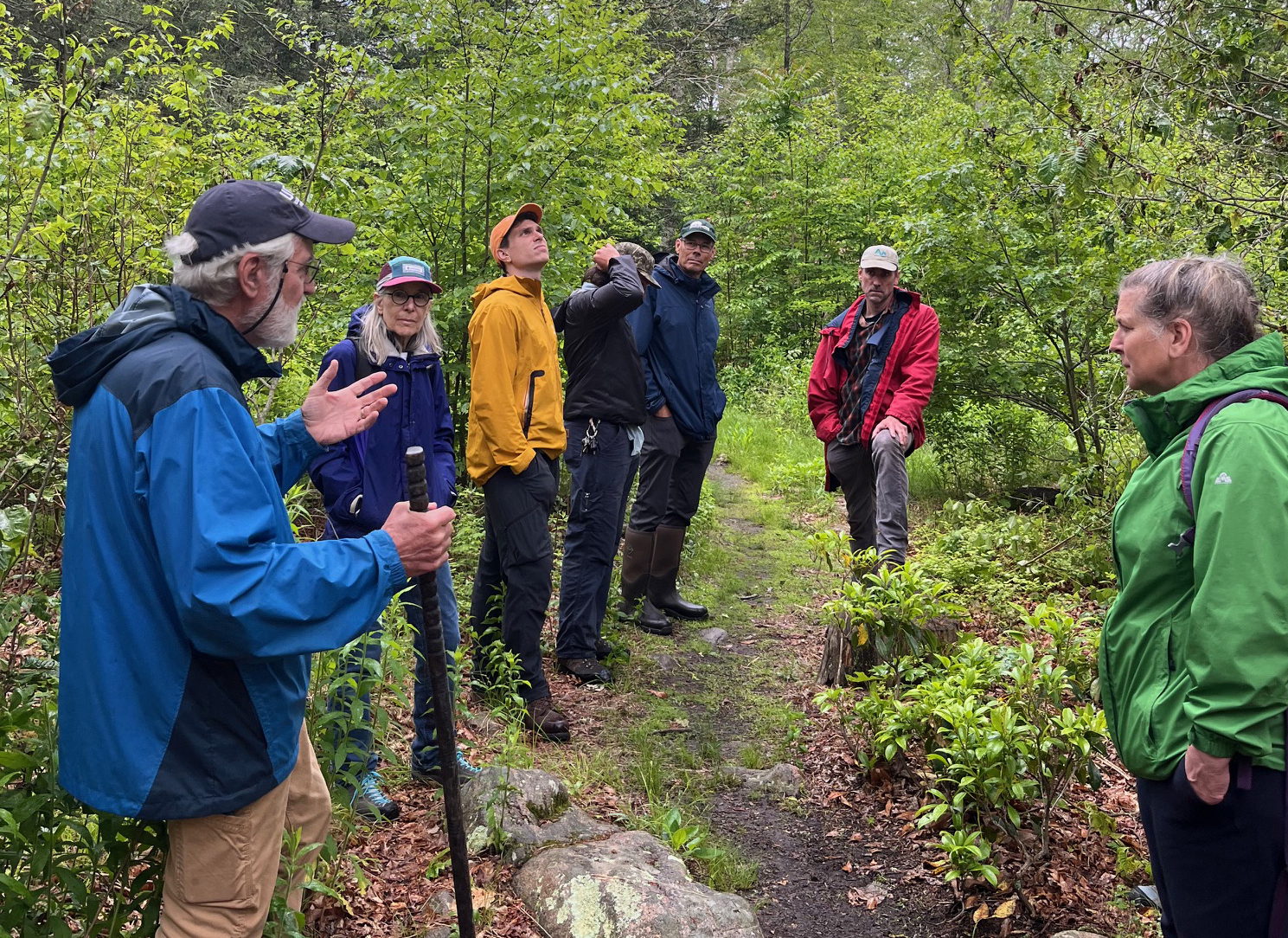
On a recent Saturday in late May, a small group of land stewards and forestry professors visited Avalonia’s Hoffman Evergreen Preserve in Stonington. They came to discuss the efforts made to plan the future of the forest for climate change over the next 30-50 years, and to observe the results of the substantial steps already taken to improve the health of a forest that was struggling.
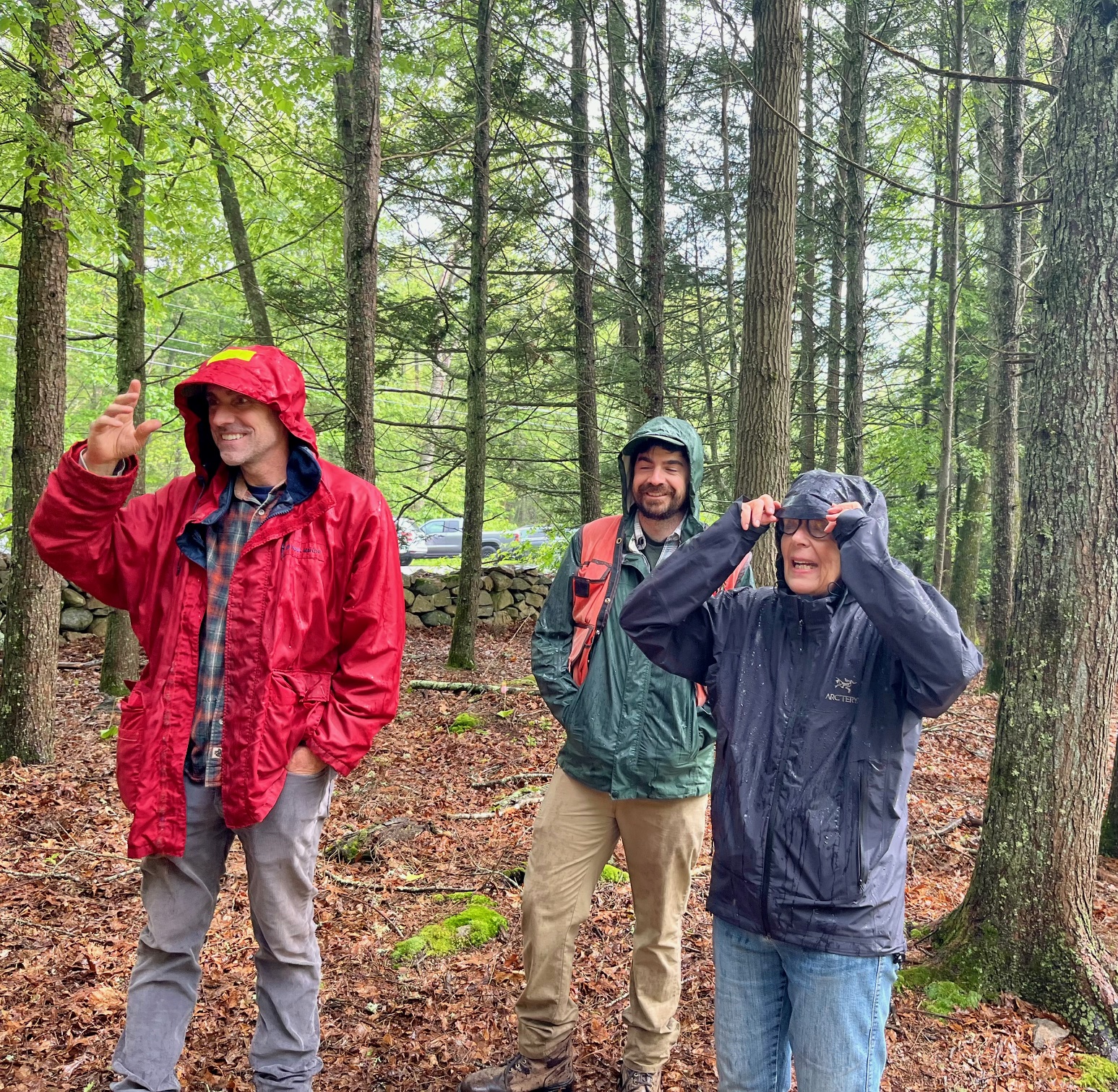
Toby Glaza, Frank Cervo, and Beth Sullivan get ready for more rain
Image 4 of 4
The field trip was organized by Ricky Bentley of the Connecticut Land Conservation Council (CLCC), an organization that helps land conservation efforts across Connecticut. Bentley is the Climate Smart Stewardship Coordinator; he connects land trusts with the resources to plan, implement, and sustain locally appropriate climate-smart practices. Other members of the group included a forester from DEEP, forestry professors, stewards from across Connecticut, and members of Avalonia, including Avalonia’s own steward, Toby Glaza. The field trip was led by Beth Sullivan (former Stonington Town Chair) and Juliana Barrett (forestry professor at UConn, Avery Point) who worked tirelessly to transform the Hoffman Preserve from a struggling forest to an increasingly healthy one.
The Hoffman Preserve is a demonstration site for smart forestry in an era of climate change. In 2018, this forest was suffering from dying oaks and ashes, an overabundance of hemlocks beset by woolly adelgid disease, and a lack of light on the forest floor. After careful consultations with forest experts, Avalonia initiated an environmentally sensitive forest harvest that affected nearly a third of Hoffman’s 200 acres. There were five large patch cuts (clear cuts in the center of forested areas), and disruptions from the logging trails.
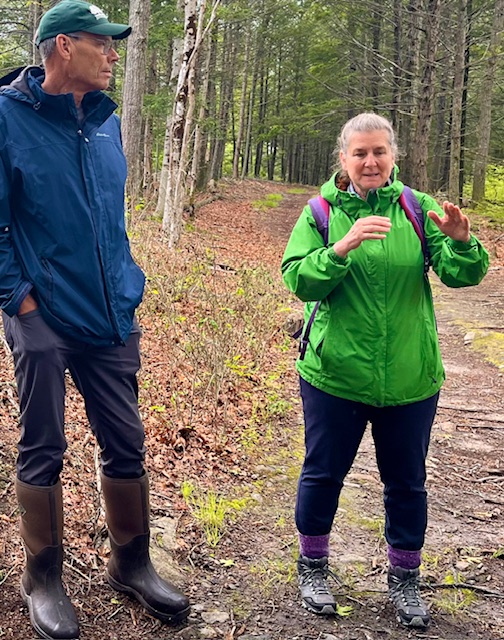
Julianna Barrett explains the advance migration planning process for each patch cut
The next step was to plan Hoffman’s regeneration employing adaptive forest management, a process based on models of climate change that could predict the types of trees and shrubs that might thrive in this area in 30 or more years. Professor Juliana Barrett of UCONN, an expert on coastal forests of Connecticut, applied for a successful grant from the Long Island Sound Futures fund. The funding allowed her to guide the selection of trees and shrubs that reflected climate-smart principles.
Twelve different tree and shrub species were carefully selected for their potential to survive and thrive in the forest environment that is predicted to occur, according to climate change models. It will likely be warmer overall, wetter in some months, but drier in others. Over one thousand new trees and shrubs were planted, thanks to the Avalonia Stonington Town Committee and myriad local volunteer groups. The project received generous donations in dollars and work efforts from the Stonington-area garden clubs and other organizations.
The forest stewards on this field trip observed an intense, spring green forest bristling with new growth in the areas that had been lumbered. Native black birch saplings are re-seeding in vast numbers. The problems faced by the hemlocks persist, but there was healthy growth at the branch tips. Although it is hard to spot the new trees and shrubs planted intentionally to survive climate change amid the profusion of spring growth, each has been GIS mapped by Barrett, and may be seen in the future. A clear picture of the results will take years, if not decades.
Tom Worthley (UCONN) talks about planning the forest
One of the members of the field trip, UCONN professor Tom Worthley, challenged the Hoffman Forest stewards to imagine what this forest should look like in 50 years and then work backward to think about planning in 10-year increments. He suggested a series of management plans to achieve that 50-year goal, albeit flexibly. Ricky Bentley (https://ctconservation.org.climate-smart-stewardship-in-action/) summarized Worthley’s forestry principles for climate change, or adaptive management as:
Resistance, which focused on promoting and maintaining oak and hickory stands. Part of the strategy involved a shelterwood cut, a silviculture technique where a significant portion of mature trees are removed while leaving some mature trees behind to provide shelter and natural regeneration for new seedlings.
Resilience, which included several patch cuts to increase age and species diversity while removing mid-story shade trees like black birch and maple.
Transition, which featured large patch cuts in areas with high oak mortality from spongy moth and replanting with species such as southern oaks that are well-adapted to future climate projections.
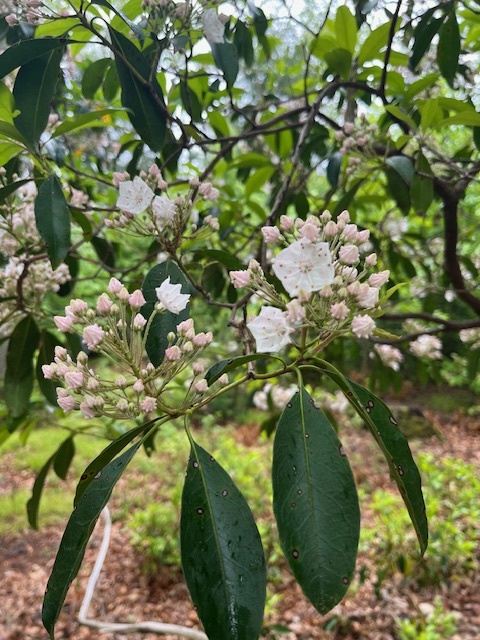
The mountain laurel puts on a show
Image 1 of 3
But for the present, the photos taken during this field trip moistened by a gentle rain clearly show, the Avalonia Hoffman Preserve, and its inhabitants are thriving. Plant and animal species are diversifying through interventions that were human-initiated or natural. The cleared patch cuts and disrupted logged areas now provide thickets that are cover for birds and bunnies. The tops of Introduced redbuds and loblolly pines poke out above the masses of black birch saplings. And to the distinguished forestry visitors on the field trip, the Hoffman Preserve offered a spectacular springtime show of native pink mountain laurel and fat lady slipper orchids.